Percentage vs percentile: what your score report means
A percentage score measures how much of a test you got right; a percentile rank measures how many people you scored above. The same score can be a high percentage and a low percentile.
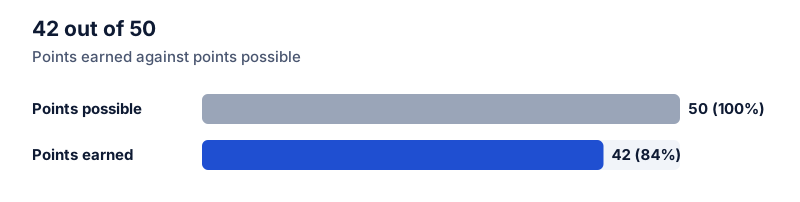
A percentage score is your points out of the total: 78 out of 100 is 78%. A percentile rank compares you with other test takers: the 70th percentile means you scored higher than about 70% of them. The same 78% could be the 70th percentile in one group and the 40th in another.
On this page
Score reports for standardized tests, and some class reports, show two numbers that look similar but answer different questions.
Percentage score: how much you got right
percentage score = points earned ÷ points possible × 100
78 points out of 100 is 78%. It depends only on your answers and the test, not on anyone else. The test score guide covers this.
Percentile rank: where you stand in a group
A percentile rank tells you what share of test takers scored below you.
percentile rank ≈ number scoring below you ÷ number in the group × 100
In a class of 30, if 21 students scored below your 78, your percentile rank is 21 ÷ 30 = 70th percentile.
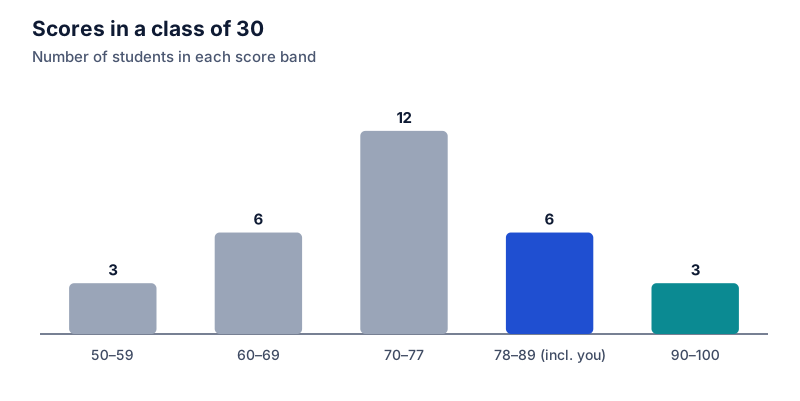
Try it: 21 of 30 students scored below you
Open in calculatorSame score, different percentiles
Your percentile depends on who else took the test. Put the same 78% in a stronger class where only 12 of 30 scored lower, and it’s the 40th percentile.
Try it: 12 of 30 scored below you
Open in calculator| Percentage | Percentile | |
|---|---|---|
| Class A | 78% | 70th |
| Class B | 78% | 40th |
Nothing about your answers changed. Only the comparison group did.
Why tests report percentiles
Standardized tests are built to compare people, and raw percentages vary from one version of a test to another. A percentile tells admissions offices, schools or parents how a score compares with a reference group, often a large national sample rather than the people in your room.
Definitions vary slightly
Different organizations calculate percentile ranks in slightly different ways. Some count half of the people with exactly your score as “below” you; some use “at or below”. For large groups the difference is small. For a class of 30 it can shift a percentile by a few points.
Percentiles aren’t evenly spaced in points
Most test scores cluster in the middle. Moving from the 50th to the 60th percentile may take only a few more points, while moving from the 90th to the 99th may take many. So a percentile gap doesn’t tell you how far apart two scores are in points.
Quick ways to keep them straight
- “I got 85%” describes your answers.
- “I’m in the 85th percentile” describes your position.
- A percentile is about people; a percentage is about points.
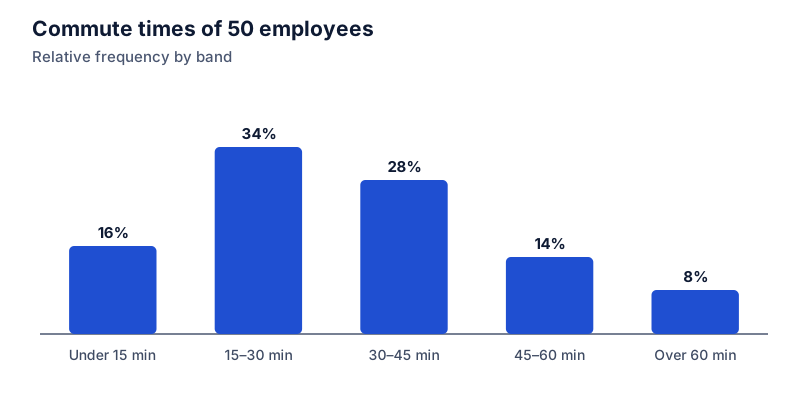
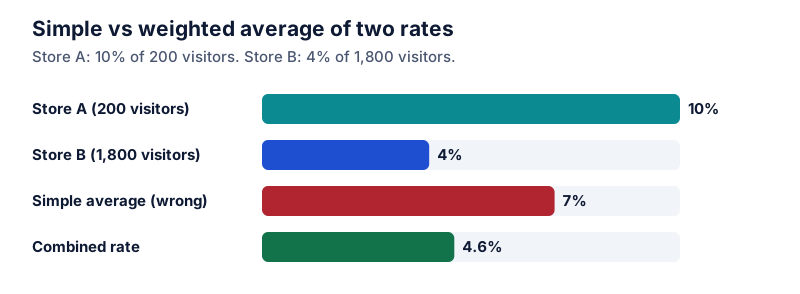
For working with groups of scores, see relative frequency percentages and average of percentages.
Questions
Can a percentile be 100?
Usually reports top out at the 99th percentile. Under the most common definition, nobody can score higher than 100% of the group, since that would include themselves.
Is a 50th-percentile score the same as 50%?
No. The 50th percentile is the median score, which could be 72% on an easy test or 35% on a hard one.
The calculator links in this guide are checked against the PercentSwift calculator every time the site is built. How we calculate explains the rounding rules. If you spot a mistake, email hello@percentswift.com.