How to calculate VAT on a net price
VAT = net price × VAT rate ÷ 100, and gross = net × (1 + rate ÷ 100). Worked invoice with a 20% standard-rate line and a 5% reduced-rate line, plus rounding and line-by-line rules.
Multiply the net price by the VAT rate as a decimal. At 20%, VAT on $1,250 is $250 and the gross price is $1,500. To go straight to the gross price, multiply by 1.2. When an invoice has lines at different rates, calculate VAT for each rate separately.
On this page
Value-added tax is a percentage added to a net price. If you’re quoting or invoicing, you need the VAT amount and the gross price for each line.
The formula
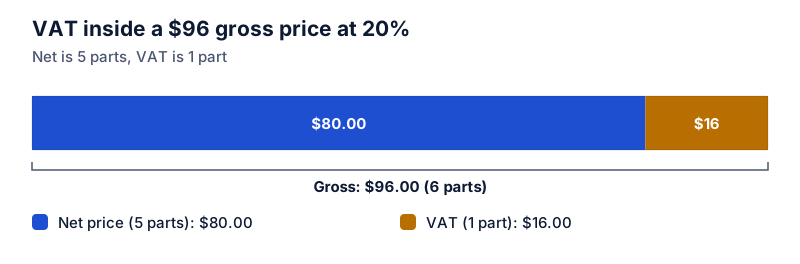
VAT = net price × VAT rate ÷ 100
Where the net price excludes VAT
gross price = net price × (1 + VAT rate ÷ 100)
Where at 20%, the multiplier is 1.2
Worked example at 20%
A consulting job priced at $1,250 net, at a 20% VAT rate:
- VAT: $1,250 × 0.20 = $250.00.
- Gross: $1,250 + $250 = $1,500.00.
Try it: $1,250 net plus 20% VAT
Open in calculatorAn invoice with two rates
Many countries apply a reduced rate to certain goods. Suppose printed materials on the same invoice are at 5%:
Try it: $480 net plus 5% VAT
Open in calculator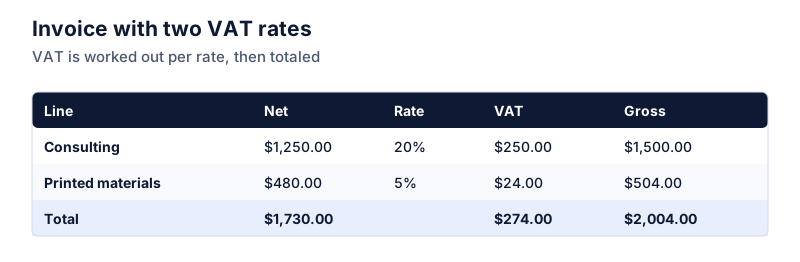
Work out VAT separately for each rate, then add the lines. Applying one rate to the $1,730 net total would give the wrong VAT: 20% would charge $346, and 5% would charge $86.50, while the correct figure is $274.
Common multipliers
| VAT rate | Multiply net by | VAT as share of gross |
|---|---|---|
| 5% | 1.05 | 4.76% (1/21) |
| 10% | 1.10 | 9.09% (1/11) |
| 20% | 1.20 | 16.67% (1/6) |
| 25% | 1.25 | 20% (1/5) |
The last column is useful when going backwards. See how to remove VAT from a price.
Rounding
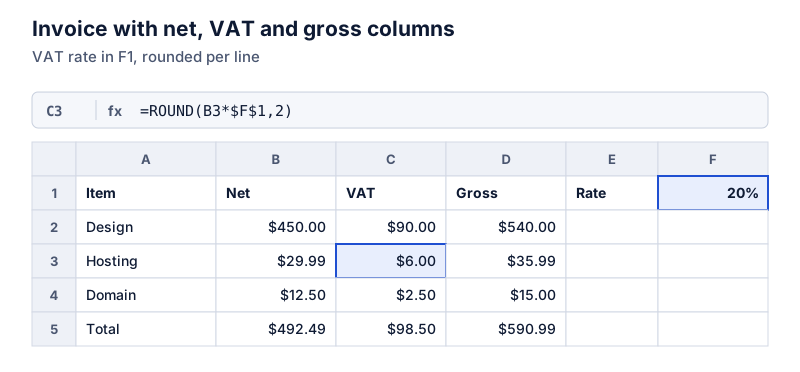
Round VAT to the smallest currency unit. Whether you round each line or only the total depends on local rules, and the two methods can differ by a cent. Pick the method your tax authority accepts and use it consistently.
Checking rates
VAT rates and which goods qualify for reduced rates differ by country and change from time to time. Use the rate published by the relevant tax authority. The calculator takes any rate you enter.
In a spreadsheet
With the net price in B2 and the rate in C2 (formatted as a percentage), VAT is =B2*C2 and gross is =B2*(1+C2). More patterns are in VAT formulas in spreadsheets. For US-style sales tax, see how to calculate sales tax.
Questions
What's the difference between VAT and sales tax?
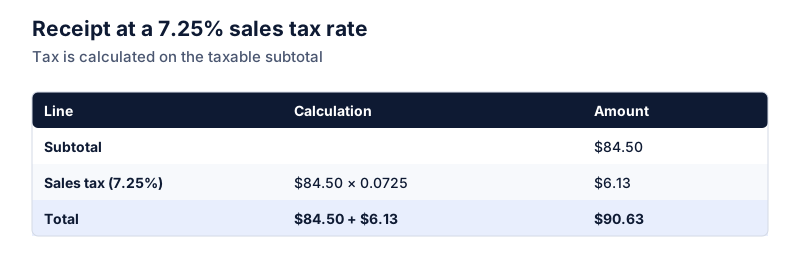
Sales tax is generally charged once, at the final sale to the consumer. VAT is charged at each stage of production and distribution, and registered businesses usually reclaim the VAT they paid on their purchases. The arithmetic for adding either to a price is the same.
Should VAT be rounded per line or on the total?
Tax authorities set the rules, and they often allow either method if used consistently. Line-by-line rounding can differ from total-level rounding by a cent or so. Check the guidance for the country you’re invoicing in.
The calculator links in this guide are checked against the PercentSwift calculator every time the site is built. How we calculate explains the rounding rules. If you spot a mistake, email hello@percentswift.com.