How much did my grade improve? Points vs percent
When a score goes from 60% to 75%, it improved 15 percentage points, 25% relative to the old score, and closed 37.5% of the gap to 100%. When to use each.
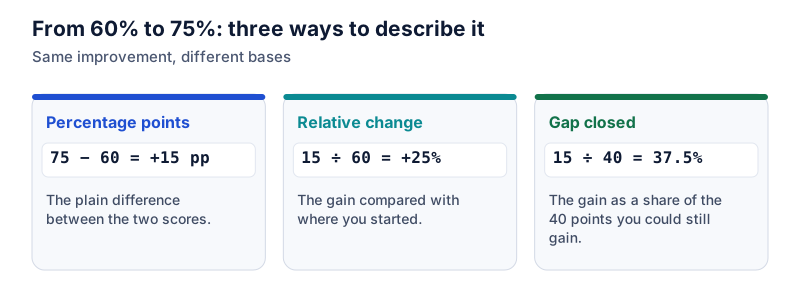
A rise from 60% to 75% can be described three ways: +15 percentage points (the plain difference), a 25% improvement (15 ÷ 60), or 37.5% of the remaining gap closed (15 ÷ 40). All three are correct. Use points by default and say which measure you mean.
On this page
Your score went from 60% to 75%. How much did it improve? There are three reasonable answers.
1. Percentage points: +15
When both numbers are percentages, the plain difference is in percentage points. 75 − 60 = 15 points. This is the clearest way to describe a change in scores.
Try it: 60% to 75%
Open in calculator2. Relative improvement: +25%
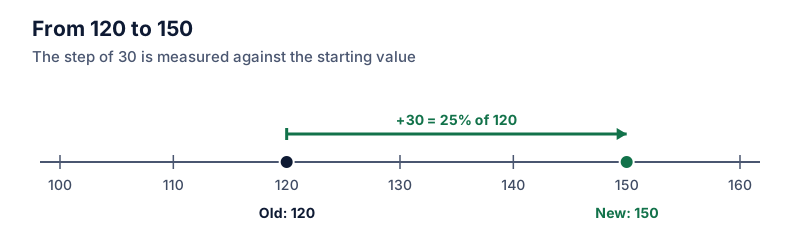
Compared with the starting score, the gain is 15 ÷ 60 = 0.25, a 25% improvement. This tells you how much better the new score is relative to the old one.
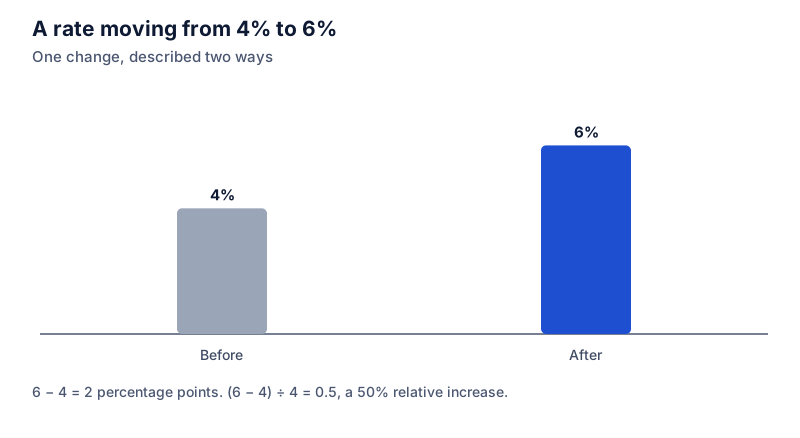
It’s easy to inflate improvement this way. A student going from 20% to 30% has a 50% relative improvement, which sounds bigger than the 25% for 60% to 75%, even though the second student gained more points and has a much higher score.
3. Share of the gap closed: 37.5%
From 60%, you could have gained at most 40 points. You gained 15 of them: 15 ÷ 40 = 37.5% of the gap closed. Some teachers and researchers prefer this measure (sometimes called normalized gain) because it doesn’t penalize students who start high and have less room to grow.
Try it: 15 of the 40 possible points gained
Open in calculatorComparing two students
| Before | After | Points | Relative | Gap closed | |
|---|---|---|---|---|---|
| Student A | 60% | 75% | +15 | +25% | 37.5% |
| Student B | 85% | 92% | +7 | +8.2% | 46.7% |
Student A gained more points and more relative improvement. Student B closed a bigger share of the remaining gap. Which student “improved more” depends on which question you’re asking.
Avoiding the most common error
Saying “my grade went up 15%” when you mean 15 points is very common. It’s not technically wrong in casual speech, but it’s ambiguous: a reader could take it as a 15% relative increase (60% → 69%). Use “points” when you mean the difference.
When the scores aren’t percentages
If you scored 42 then 51 on a 60-point test, the improvement is 9 points, which is 9 ÷ 42 = 21.4% relative. As percentages of the test, the scores are 70% and 85%, so the improvement is also 15 percentage points. Convert to percentages first if you want to compare tests with different totals.
For the general concept, see percentage points vs percent. For the underlying calculation of relative change, see how to calculate percentage increase.
Questions
Which one should I put on a report?
Percentage points, with both scores: “from 60% to 75%, up 15 points”. It’s the hardest to misread.
Why does the same gain look bigger for a weaker student?
Relative change divides by the starting score. A 15-point gain on 30% is a 50% improvement, while the same gain on 80% is under 19%.
The calculator links in this guide are checked against the PercentSwift calculator every time the site is built. How we calculate explains the rounding rules. If you spot a mistake, email hello@percentswift.com.