Percentage difference calculator
Enter two values to see how far apart they are as a percentage of their average. Use this when neither number is the “before” value. Otherwise use the % change tab.
Percentage difference between two values
Settings
Percentage difference
The percentage difference between 80 and 100 is 22.222222%.
Rounded to 6 decimal places- Absolute difference
- 20
- Average of the two values
- 90
Formula
Difference % = |A − B| ÷ ((|A| + |B|) ÷ 2) × 100
Steps
- Find the absolute difference: |80 − 100| = 20
- Find the average: (80 + 100) ÷ 2 = 90
- Divide and multiply by 100: 20 ÷ 90 × 100 = 22.222222%
- Percentage difference treats both values the same way. To measure a change from an old value to a new one, use percentage change instead.
Recent calculations
Exact decimal arithmetic, calculated in your browser.
Examples
Each one loads into the calculator above.
The formula
Percentage difference = |A − B| ÷ ((|A| + |B|) ÷ 2) × 100. For 80 and 100, the difference is 20 and the average is 90, so the answer is 20 ÷ 90 × 100 ≈ 22.22%.
Because the formula divides by the average, the answer is the same whichever value you enter first.
Difference or change?
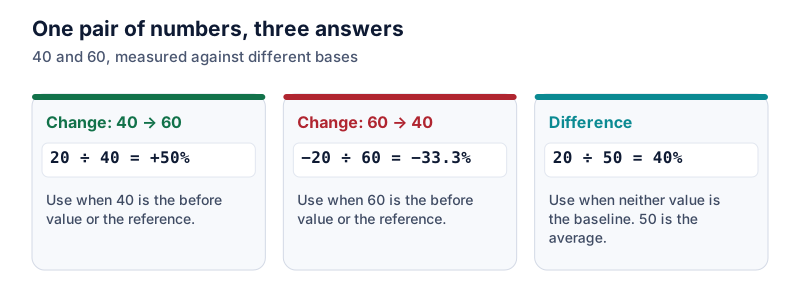
Use percentage change when one value clearly comes first or acts as the reference: last year and this year, the list price and the sale price, the budget and the actual spend. From 80 to 100 is a 25% increase, and from 100 to 80 is a 20% decrease.
Use percentage difference when the two values are on an equal footing: two suppliers’ quotes, two measurements of the same thing, the price of one product in two shops. Neither is the baseline, so neither should be the divisor.
Reporting a percentage difference as if it were a change, or the reverse, is a common source of disagreement in reports. If you aren’t sure, say which formula you used.
When it breaks down
When both values are 0 they are identical and the difference is 0. When the two values have opposite signs, the average of their absolute values can be small compared with the gap, and the percentage stops being a useful summary. In that case, report the difference in units.
For lab work where one value is the accepted or true value, you probably want percent error, which divides by the accepted value rather than the average.
Questions people ask
Guides that use this calculator
 Increase and decrease
Percentage change vs percentage difference: which one to use
Use percentage change when one value is clearly the starting point, and percentage difference when neither is. The same pair of numbers worked both ways.