How many questions do I need right to pass?
Multiply the number of questions by the pass percentage and round up to the next whole question. What to do when questions are worth different points.
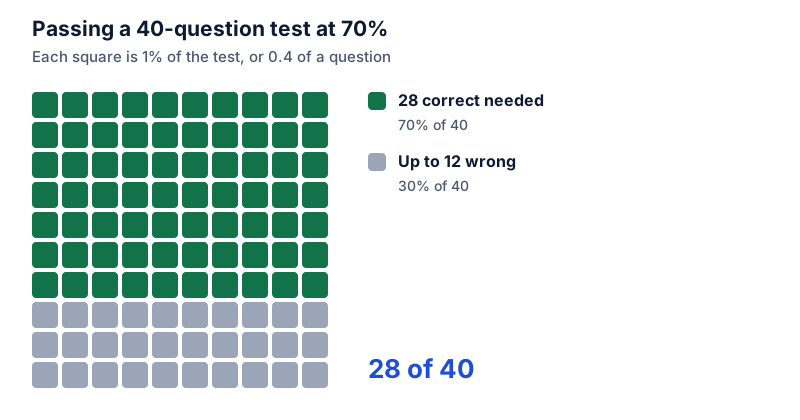
Multiply the total number of questions by the pass percentage, then round up. To pass a 40-question test at 70%, you need 0.7 × 40 = 28 correct. At 70% of 35 questions the result is 24.5, so you need 25, since you can’t answer half a question.
On this page
minimum correct = number of questions × pass percentage ÷ 100, rounded up
A 40-question test with a 70% pass mark: 0.7 × 40 = 28 correct answers. You can get up to 12 wrong.
Try it: 70% of 40 questions
Open in calculatorRounding up
When the result isn’t a whole number, round up. 70% of 35 questions is 24.5. Answering 24 correctly gives 24 ÷ 35 = 68.6%, which fails. You need 25, which gives 71.4%.
Try it: 70% of 35 questions
Open in calculatorSome exams state the pass mark as a number of questions or points instead of a percentage to avoid this ambiguity. If yours does, use that number.
Quick reference
| Questions | 60% pass | 70% pass | 75% pass | 80% pass |
|---|---|---|---|---|
| 20 | 12 | 14 | 15 | 16 |
| 25 | 15 | 18 | 19 | 20 |
| 30 | 18 | 21 | 23 | 24 |
| 40 | 24 | 28 | 30 | 32 |
| 50 | 30 | 35 | 38 | 40 |
Values that were fractions have been rounded up: 70% of 25 is 17.5, so 18.
Questions worth different points
If questions carry different marks, work in points instead. A test has 30 one-point questions and 5 four-point questions, 50 points in total. At a 70% pass mark you need 0.7 × 50 = 35 points. That could be 27 one-pointers and 2 four-pointers, or 15 one-pointers and all 5 four-pointers.
Negative marking
Some tests subtract points for wrong answers. If each correct answer earns 1 point and each wrong answer loses 0.25, then 30 correct and 10 wrong on a 40-question test gives 30 − 2.5 = 27.5 points, or 68.75%. Leaving a question blank is usually 0, so when you’re guessing blindly, it can be better to skip.
How many can I get wrong?
Subtract the minimum correct from the total. On a 50-question test at 80%: 50 − 40 = 10 wrong allowed. On 30 questions at 75%, 22.5 rounds up to 23 correct, so 7 wrong.
Scaled scores
Some licensing exams and standardized tests report scaled scores, not raw percentages. The pass mark may be set on the scaled score, and the number of correct answers needed can change between versions of the test. In that case, published raw-score cutoffs (if any) are the only reliable guide.
To turn your score into a percentage, see test score percentage. For course grades with a final exam, see what score do I need on my final.
Questions
Do I round up or down?
Up. If 24.5 correct answers is the threshold, 24 is below it and 25 is the smallest whole number at or above it.
What if wrong answers lose points?
Then the number of correct answers isn’t enough. Work out your net score (points for correct answers minus penalties) and compare that with the pass score.
The calculator links in this guide are checked against the PercentSwift calculator every time the site is built. How we calculate explains the rounding rules. If you spot a mistake, email hello@percentswift.com.